 English
 Pусский
 Español
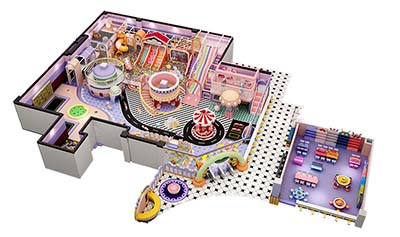
Walk into any family entertainment center (FEC) today, and you’ll likely see a familiar dilemma playing out: a child staring up at a towering rocket-ship slide. At the same time, their younger sibling pulls them toward a pastel donut-shaped ball pit. Both space robot and candy themes are among the most popular choices for indoor playgrounds in 2025—but which one actually delivers better returns over the lifetime of your investment?
This article breaks down the two themes across five critical dimensions: child psychology, visual design, operational revenue potential, space requirements, and target age range. By the end, you'll have a practical framework to match the theme to your specific venue, location, and business goals—without a single product pitch.
Beyond Aesthetics—What Makes a Theme “Work” for Different Age Groups?
Every theme sends a different psychological signal. Understanding what that signal communicates to children—and their parents—is the first step in choosing wisely.
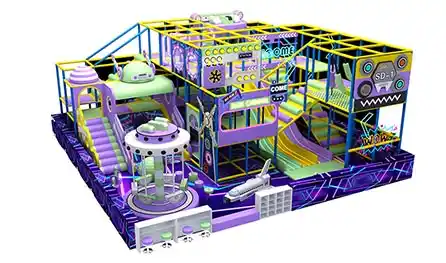
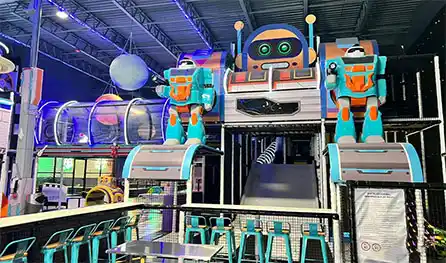
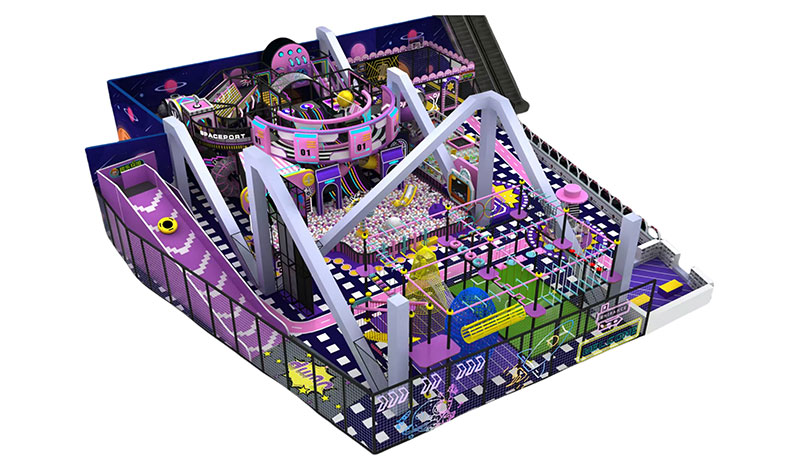
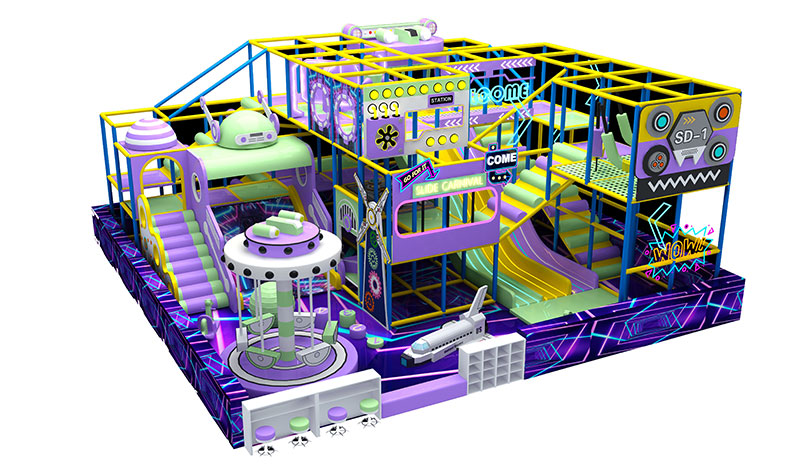
Space robot themes tap into children’s natural curiosity about exploration, discovery, and future possibilities. Designs often feature rocket-shaped towers, asteroid-climbing walls, nebula LED lighting, and interactive mission panels where children “travel through galaxies.” This theme appeals strongly to children who are drawn to active problem-solving, role-play scenarios ("I'm an astronaut exploring Mars!”), and narratives of bravery and teamwork. Research into children’s fantasy preferences suggests that they often favor story elements that feel precedent-driven and logically coherent within the fictional world—a quality that space exploration narratives naturally deliver.
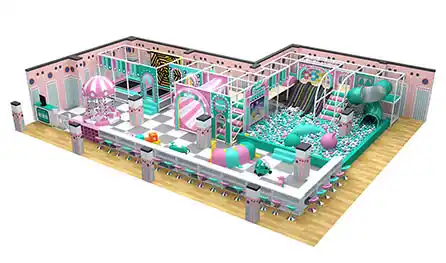
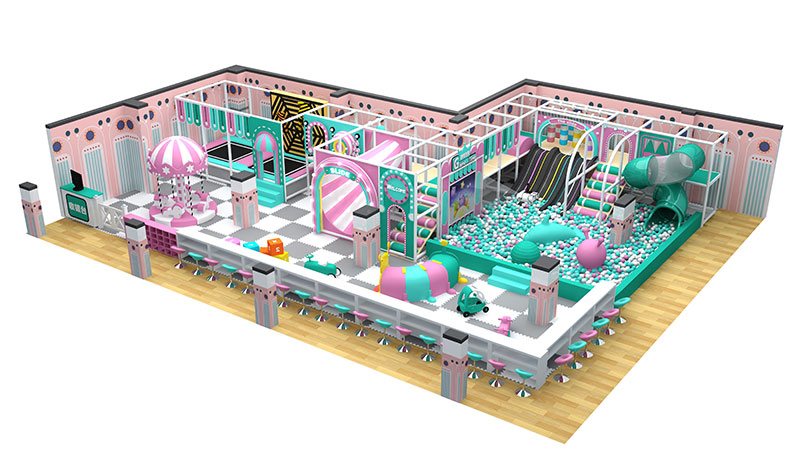
Candy theme, by contrast, operates on sensory and emotional resonance. The signature pastel palette—bubblegum pink, sky blue, creamy yellow—is associated with calmness, warmth, and happiness in color psychology. When children see oversized lollipop climbing poles or cotton-candy spiral slides, the brain anticipates reward, generating a dopamine response similar to the anticipation of actual sweets. Candy themes also trigger nostalgic joy in parents who remember the classic candy shops of their youth, creating a rare moment where both generations feel the same positive emotional pull.
Key difference in age targeting:
-
Space robot themes generally perform best for ages 4–10, with peak engagement around 5–8 when children are actively developing narrative reasoning and team play skills.
-
Candy themes have a broader floor: they appeal to toddlers through bright colors and soft shapes, remain engaging for preschoolers through fantasy play, and continue to attract early teens through the Instagram-worthy visual environment that encourages social sharing.
For a deeper look at how themed environments drive traffic across age groups, see our guide: [How to Align FEC Theme Selection with Local Demographics].
Visual Impact vs. Staying Power—Comparing Design Language and Operational Reality
Space Robot Theme: High-Tech Immersion
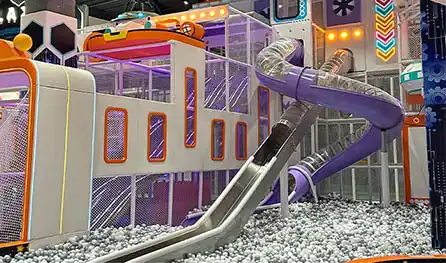
Space designs lean heavily on dark or deep purple backgrounds with neon accents. These elements create a dramatic, immersive environment that excels at drawing children into active, goal-oriented play. The dark backdrop also makes interactive technology stand out more clearly—motion-sensor panels, digital climbing walls, and mission completion screens are easier to see and use.
-
Longevity: The sci-fi aesthetic tends to age well because it is not tied to specific cartoon franchises or passing trends.
-
Operational consideration: Darker color schemes show fewer stains from everyday use, but require consistent lighting maintenance to keep the immersive effect intact.
Candy Theme: High-Visibility Social Magnet
Candy aesthetics are engineered for shareability. The hallmark combination of soft pastels and vibrant accent colors creates a dreamy, fantasy environment that photographs beautifully across a range of lighting conditions. Every corner of a candy-themed playground acts as a potential photo opportunity for parents posting on social media, effectively turning visitors into unpaid brand ambassadors.
-
Longevity: Candy designs are less affected by seasonal fashion cycles because sweetness is a timeless emotional cue.
-
Operational consideration: Lighter pastel surfaces require more frequent cleaning to maintain their pristine appearance, and high-touch areas may show wear faster than darker tones.
Space Robot Theme vs. Candy Theme — Design & Operational Comparison
| Feature | Space Robot Theme | Candy Theme |
|---|---|---|
| Primary color palette | Dark purples, neons, metallic grays | Pastel pinks, sky blues, creamy yellows |
| Key design elements | Rocket towers, asteroid climbers, LED tunnels | Lollipop poles, donut slides, marshmallow clouds |
| Instagram shareability | Moderate — requires good lighting | High — photogenic in most lighting |
| Stain visibility | Low — dark tones hide daily wear | Moderate to High — pastels show more |
| Maintenance complexity | Lighting systems require periodic bulb/LED replacement | Surface cleaning requires a higher frequency |
| Technology integration | Excellent — dark background enhances projection and AR | Moderate — bright colors compete with digital displays |
| Themed upsell pathways | Astronaut training certificates, mission passports | Candy café drinks, sweet-inspired merchandise |
Curious about how technology integration can boost repeat visitation? Explore how projection mapping and interactive panels can extend play value: [Interactive Technology Integration for FECs].
Revenue Generation — Where Does Each Theme Drive the Highest Margins?
The economic case for each theme goes beyond ticket sales.
Candy themes drive stronger secondary revenue than other concepts, as their visuals translate easily to retail and F&B. Kids enjoying candy-shaped play structures are more likely to purchase matching treats and souvenirs. Many operators launch on-site Candy Cafés aligned with playground designs, lengthening stays and lifting per-customer spend. Industry data shows that malls with creatively themed playgrounds see 20–30% more family foot traffic and 15–25% better retail sales vs. plain play spaces.
Space robot themes rely on engagement loops instead of instant retail sales. Unlike candy concepts with straightforward F&B tie-ins, they thrive on mission-driven upsells. Operators use Space Mission Passports: kids collect stamps by finishing zone challenges, driving repeat visits and immersive storytelling. These venues also profit from birthday bundles featuring mission invites, astronaut outfits, and supervised group games.
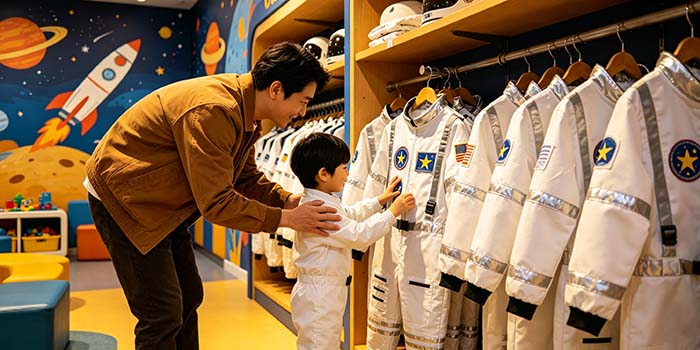
Profit strategy tie-breaker: High-traffic mall/tourist sites prioritizing F&B and merchandise should pick candy for easier upsells. Destination/suburban venues leaning on memberships and birthday bookings gain better story-backed customer retention with space robot themes.
Space and Height Constraints — Matching the Theme to Your Physical Venue
Not every theme fits every space. Your ceiling height and floorplate shape directly influence which design concept works best.
Low-to-moderate ceiling height
At these heights, two-level structures are typical. Candy themes often perform well here because oversized decorative elements (lollipop pole,, donut slides) can be scaled down while retaining visual recognizability. The soft, rounded shapes of candy equipment also feel appropriate in smaller spaces where sharp angles would feel aggressive.
High ceiling height
Tall spaces allow for three or more levels, zip lines, and adventure towers. Space robot themes are particularly well-suited to tall venues because the verticality can be framed as “climbing through the galaxy“ or ”ascending to a space station.” The dark backdrop and LED lighting also work more effectively at height, drawing the eye upward and making the entire structure feel like a cohesive universe rather than a disconnected set of platforms.
Floorplate shape consideration:
-
Narrow, deep layouts: candy themes tend to feel warmer and less oppressive in long, narrow configurations
-
Square or wide layouts: space themes can create dramatic sightlines and multiple distinct zones (planetary landing zone, rocket command, asteroid belt)
For a full discussion of how ceiling height affects equipment selection and layout planning, see: [Space Optimization for Indoor Playground Layouts].
Real-World Benchmark — What Recent Installations Tell Us
A 350㎡ space playground launched in Indonesia in late 2025, fitted with LED lights, slides, tunnels, ball pools and climbing gear to spark imagination and exercise. Built to EN1176 and ASTM safety standards, it quickly became a local family hotspot. The operator reported outstanding design and operational support, with its immersive space storyline bringing back guests to finish mission tasks.
Space concepts prove popular across Southeast Asia, with new sites in Malaysia, Vietnam and Thailand backed by local investors and mall developers. Space robot themes translate cross-culturally, as kids worldwide are fascinated by astronauts, rockets and outer space.
Candy playgrounds dominate social media-focused markets. Their photo-ready aesthetics cut customer acquisition costs via organic user sharing. Industry reports state candy setups turn plain mall spots into viral photo hubs, expanding exposure with minimal extra marketing investment.
Making Your Decision — A Practical Framework for Theme Selection
Rather than asking “which theme is better,” ask “which theme is better for my specific situation.” Consider the following five questions:
1. What is your primary age target?
-
Heavy toddler/preschool focus: candy’s soft shapes and bright colors offer clearer appeal.
-
Balanced mix of preschool and school: space offers better longevity as children mature.
-
Teen inclu: neither is ideal alone; consider adding a vertical/adventure zone space-themetheme base.
2. Where is your venue located?
-
High-traffic mall: Candy’s social media magnetism can multiply footfall.
-
Destination FEC or suburban strip: the space’s mission-repeat mechanism works well for membership models.
-
Tourist area with international visitors: space travels better across cultures; candy may need local taste calibration.
3. What percentage of your revenue comes from F&B and retail?
-
High: candy provides natural upsell pathways.
-
Low: Space’s ticket and party revenue focus is a closer fit.
4. What are your local competitors doing?
-
If existing venues use dark, high-tech themes, candy can differentiate.
-
If competitors rely on generic, bright, and colorful playgrounds, space offers novelty.
-
Avoid directly copying the dominant theme unless you can clearly outperform on execution.
5. What is your maintenance budget and staffing capacity?
-
Lower cleaning staff or budgetthe: space’s darker tones reduce visible staining between deep cleans.
-
Adequate cleaning staffing and higher tolerance for upkeep: candy delivers strong visual ROI but demands consistent surface care.
Next Steps — From Theme Decision to Equipment Specification
Once you have clarified these key decision factors—target age range, location type, revenue mix, competitive landscape, and operational capacity—comparing the specific features of available equipment configurations becomes the next logical step. You can review Xingjian’s space-themed and candy-themed playground solutions to understand how modular layouts, safety compliance (ASTM F1487-25 and EN117),, and customization options translate your chosen theme into a build-ready design.
Related Reading
-
How to Assess Local Market Demand Before Selecting an Indoor Playground Theme
-
Space Optimization for Indoor Playground Layouts: From Concept to Floorplan
-
Interactive Technology Integration for FECs: AR, Projection Mapping, and Digital Play
-
5 Common Theme Selection Mistakes and How to Avoid Them in Your FEC Investment
-
The Role of Color Psychology in Children’s Play Environment Design
This article is part of Xingjian’s technical content library. No direct sales or pricing information is included. All technical discussions aim to help you make informed purchasing decisions.